
Choosing a solar inverter involves more than checking its power rating. You also need to consider battery support, solar charging, backup performance, and system compatibility. These details affect how well your solar setup performs throughout the day.
The best hybrid solar inverter for one household may not suit another. Some systems prioritize battery storage, while others focus on grid interaction or off-grid operation. Understanding these differences helps you compare available models without paying for features you don’t need.
A hybrid solar inverter with mppt technology can also improve how a solar system handles changing sunlight. However, its actual performance depends on the controller specifications, panel arrangement, and operating conditions. Looking at these details provides a clearer picture than relying on product descriptions alone.
What Is a Hybrid Solar Inverter, and How Does It Differ From a Standard Inverter?
A hybrid solar inverter manages electricity from solar panels, batteries, and, in supported systems, the utility grid. It converts direct current from solar panels or batteries into alternating current for household appliances. Depending on its design, it can also charge batteries and coordinate different power sources.
A standard grid-tie inverter mainly converts solar electricity for immediate use or grid export. It usually doesn’t provide battery backup without additional equipment. Hybrid models combine more functions in one unit, although their capabilities vary by model.
Key Features to Examine Before Choosing an Inverter
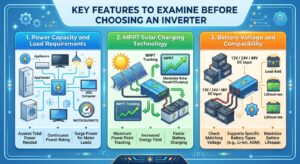
Power Capacity and Load Requirements
Start by calculating how much electricity your essential appliances consume. Refrigerators, fans, lighting, computers, and water pumps have different power requirements. Some equipment also draws extra power when starting.
Check both continuous output and surge capacity. Continuous output indicates how much power the inverter can supply during normal operation. Surge capacity matters when motors or compressors briefly demand more electricity during startup.
MPPT Solar Charging Technology
Maximum Power Point Tracking helps a solar charge controller adjust its operating point to collect available power from solar panels. Solar output changes with sunlight intensity, temperature, and shading. MPPT technology responds to these conditions to improve energy harvesting.
When comparing a hybrid solar inverter with mppt, examine its maximum PV input voltage, charging current, and supported solar array capacity. These specifications determine which panel configurations the inverter can accommodate. A higher charging current alone doesn’t guarantee better overall performance.
Battery Voltage and Compatibility
Battery compatibility is another important consideration. Some hybrid inverters support 12V, 24V, or 48V battery systems, while others work with specific voltage configurations. The correct choice depends on your planned system size and storage requirements.
Check whether the inverter supports lead-acid, lithium-ion, or other battery types. Lithium batteries may require communication between the battery management system and inverter. Confirming supported communication protocols can help prevent compatibility problems.
Comparing Grid-Tie, Off-Grid, and Hybrid Systems
The right inverter type depends on how you plan to use solar energy. Each design handles grid electricity, battery storage, and backup power differently.
Is a Hybrid Solar Inverter Better Than a Grid-Tie or Off-Grid Inverter?
A grid-tie inverter suits systems designed mainly to use solar power and send excess electricity to the grid. It generally costs less to install than a complete hybrid system because it doesn’t need battery management. However, standard grid-tie models usually shut down during a power outage for safety.
Off-grid inverters serve properties that operate independently of the utility grid. They rely on solar panels and battery storage to supply electricity. Hybrid inverters combine several functions, making them useful when a property needs both grid interaction and backup power.
Hybrid vs. Off-Grid Inverter: Which Is Right for a New 48V System?
A 48V battery system can support substantial loads while keeping battery-side current lower than comparable 12V or 24V arrangements. This can reduce some wiring challenges in larger installations. However, battery capacity, cable sizing, and inverter limits still matter.
An off-grid inverter is suitable for locations without reliable grid access. A hybrid model may be more practical when grid electricity is available but occasional outages require backup. Before choosing either type, check whether its charging settings and battery communication features match your planned equipment.
Efficiency, Backup, and Energy Management
Conversion Efficiency and Power Losses
An inverter loses some energy when converting electricity from one form to another. Its efficiency rating indicates how much input energy becomes usable output under specified test conditions. Actual performance changes with load, temperature, and operating mode.
Compare maximum efficiency alongside weighted or European efficiency when available. These figures offer different perspectives on performance. Also consider whether the inverter consumes electricity while waiting or operating without a significant load.
Backup Output and Transfer Time
Backup capability matters when electricity interruptions affect essential equipment. Check which output terminals remain active during an outage and how much power they can supply. Some models offer a separate backup output for selected household circuits.
Transfer time describes how quickly the inverter switches to backup power after grid failure. Sensitive electronics may need a short interruption or a separate uninterruptible power supply. Review the manufacturer’s specifications instead of assuming every hybrid inverter provides uninterrupted power.
Do Hybrid Inverters Export Solar Electricity to the Grid?
Some hybrid inverters support grid export, allowing excess solar generation to flow back into the utility network. Others are designed mainly for self-consumption and backup. Export capability depends on the inverter’s design, configuration, and local utility requirements.
An off-grid inverter normally operates without exporting electricity to the grid. If exporting energy is part of your plan, check the model’s grid connection features and applicable approval requirements. Never assume that a hybrid label automatically means a unit supports grid export.
Practical Design and Installation Considerations
Are All-in-One Hybrid Inverters Less Efficient Than Separate Components?
An all-in-one hybrid inverter combines several functions in a single unit. It may include a solar charge controller, battery charger, and inverter. This arrangement can simplify installation and reduce the number of separate components.
Separate components offer more flexibility when designing or upgrading a solar system. However, they can require additional wiring and careful coordination. Neither design is automatically more efficient. Compare the conversion stages, standby consumption, and manufacturer efficiency figures before deciding.
Can a Hybrid Inverter Work With Solar Panels Only, Without a Grid?
Some hybrid inverters can operate with solar panels and batteries without a utility connection. Their ability to do so depends on the operating modes supported by the manufacturer. Certain models require a battery to start, while others support battery-free operation.
If you plan to use solar power independently, check the inverter’s startup requirements and minimum battery settings. You should also consider what happens during cloudy weather or after sunset. A suitable battery capacity helps maintain a stable electricity supply when solar generation falls.
Why Do Some Hybrid Inverters Receive Poor Reviews?
Customer reviews can reveal useful information about installation difficulties, software problems, noise, and customer support. However, a low rating doesn’t always reflect the inverter’s actual technical performance. Some complaints result from incorrect installation or unsuitable system configurations.
Look for recurring complaints rather than relying on isolated experiences. Pay attention to reports about warranty handling, replacement parts, monitoring applications, and battery communication. Reviews become more useful when they describe the exact model and installation conditions.
Long-Term Ownership and System Planning
What Is the Lifespan of a Hybrid Inverter’s Battery?
Battery lifespan depends on chemistry, operating temperature, charging habits, and the number of charge cycles. Lithium batteries often support more cycles than traditional lead-acid batteries, although performance varies between models. Deep discharges and excessive heat can shorten battery service life.
Check the battery manufacturer’s cycle rating and warranty conditions. Also consider the recommended depth of discharge and usable storage capacity. These details help estimate how the battery may perform over years of regular use.
Does a Budget Hybrid Inverter Make Sense Without a PV Array Yet?
Buying an inverter before installing solar panels can make sense when you’re planning a gradual system upgrade. It allows you to prepare the battery and backup arrangement before adding solar generation. However, the inverter must support your future panel configuration.
Compare the maximum PV input, MPPT voltage range, and charging capacity with your expected solar array. Also check whether the model supports the battery type you intend to purchase. Planning these details early can prevent compatibility issues during expansion.
Frequently Asked Questions
What is the most important feature of a hybrid solar inverter?
Power capacity, battery compatibility, and solar charging specifications are key considerations. The right combination depends on your electricity consumption and backup requirements.
Does a hybrid solar inverter need batteries to work?
Some models can operate without batteries, while others require battery storage for certain functions. Always check the manufacturer’s operating requirements.
How many MPPT trackers should a hybrid inverter have?
The required number depends on your solar panel layout. Multiple trackers can help manage panel strings with different orientations or shading conditions.
Can a hybrid inverter charge batteries from the grid?
Many hybrid inverters support grid charging. Their charging options and scheduling features vary by model.
How can I check whether an inverter supports my solar panels?
Compare the panel string’s voltage and current with the inverter’s PV input limits. Check the MPPT operating range and maximum solar input before installation.
Final Thoughts
Choosing a hybrid inverter requires looking beyond its advertised power rating. Battery support, MPPT performance, backup output, and grid compatibility all affect how a system operates. A careful comparison helps identify features that match your actual electricity needs.
Before making a decision, review the technical specifications and installation requirements together. Consider future expansion, available battery options, and the support offered by the manufacturer. This approach makes it easier to select an inverter that fits your current setup and long-term plans.