
When you need to paint a large object quickly and properly, the ruffles and brushes are sent to the shelf. Professionals and advanced craftsmen have long since switched to airless spraying. The method allows you to apply a dense, perfect paint layer within seconds, saving time and material.
But at the stage of equipment purchase, all inevitably fall into the main technical dispute: which pump to choose: diaphragm or piston? Both options produce paint under enormous pressure, but they are arranged very differently. In this article, we will disentangle their real differences on the construction site without excessive theory. And also explain why for most standard finishing tasks, the Italian brand Tecnover membrane machines are much more practical, reliable and profitable in service.
What is Airless Technology and How It Has Changed the Industry
In airless systems, no air is involved in the spraying process. The pump pumps paint into the hose at a colossal pressure of 200-250 bar. When passing through a tiny nozzle hole, the compound expands instantly and is crushed into tiny droplets. This process is called atomization.
The transition to an airless paint sprayers technology offers several powerful advantages:
- Minimal overspray. The paint is applied strictly to the wall, rather than flying as a cloud throughout the room;
- Composition savings. The coefficient of useful material transport to surface reaches an impressive 80-85%;
- High speed of operation. In one pass you get a dense covering layer, which accelerates the delivery of the object by 4-5 times;
- Omnipotence to materials. High pressure allows you to spray heavy soil and surface paint without extreme dilution;
- Reduced labor costs. You spend less physical effort while managing a much larger volume per shift.
Such a qualitative leap in productivity is revolutionizing the entire economy of the home painting or business.
Diaphragm Pumps: How It Works
Inside the diaphragm apparatus is a flexible plate (membrane) which performs frequent return-forward movements. Its piston shaft does not do this directly, but through hydraulic oil. The membrane completely separates the internal mechanics and the area where the paint and varnish material circulates.
Such a constructive spray painting solution gives the equipment a key advantage – the paint is in contact only with the very membrane and smooth walls of the work chamber. Abrasive particles and aggressive chemistry cannot reach the moving metal parts of the drive, which protracts the life of the unit dramatically.
Even during long work, the polymers do not overheat and the mechanical units remain in the ideal factory lubrication, which prevents a sudden pump failure right in the middle of the working day.
Piston Pumps: Mechanics and Vulnerable Areas
The piston apparatus is arranged differently: a metal rod (piston) moves inside the cylinder and directly pushes the paint. To keep the system pressure, the piston is equipped with a set of polymer and leather sealing rings.
This is where the main vulnerable area of the entire structure lies, which should be known before purchasing:
- Permanent abrasive wear. The interior and exterior paints contain chalk, silicates and marble crumbs that act as a drip;
- The appearance of micro-scratches. Solid particles inevitably scratch the mirror of the cylinder and the metal rod itself with each movement;
- Regular pressure loss. Once the seals are cleared, paint starts to seep into the mechanical unit;
- Progressive wear of the torch. When the rings are worn, the red pulley begins to give off an irregular stream with stripes at the edges (tailing);
- Expensive repair. A minor leak requires immediate shutdown of the facility and complete replacement of the reel.
Due to such direct contact with the paint material, the piston group demands fanatic discipline from the operator. If you forget to wash the machine once or don’t add lubricant in time, the hard particles of dry pigment will turn an expensive liquid block into a useless piece of metal.
Why Tecnover Membrane Devices are the Best Choice
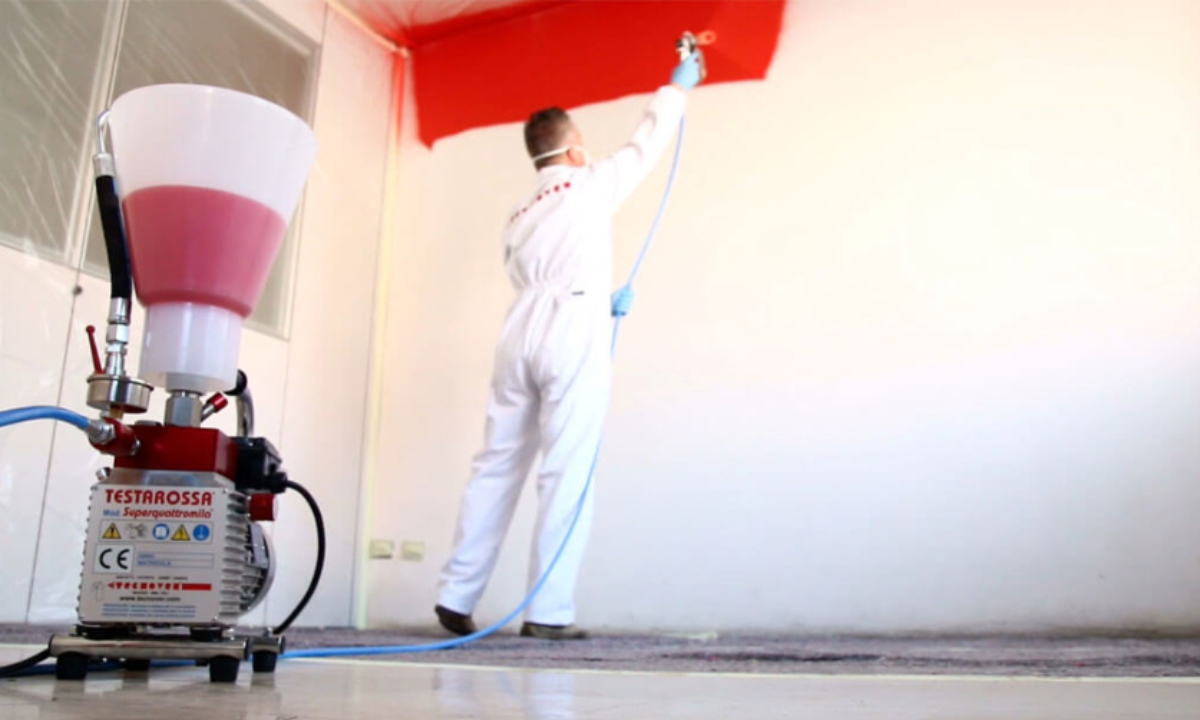
The Italian brand Tecnover has been producing professional Airless Paint Sprayers for more than 40 years. The company’s engineers deliberately perfected the membrane technology by creating unobtrusive machines that fit perfectly for real-world conditions on sites.
1. Unmatched Reliability and Working Resource
In the pistons, you need to constantly monitor the seals and regularly pour in special TSL oil. If the painter forgot to do this, the node will fail on the same day. In Tecnover systems everything is much more reliable:
- No hard friction on parts. The hydraulic cushion inside the pump fully compensates for mechanical loads;
- Resistance to harsh chemicals. Membrane is not afraid of aggressive solvents, xylene and acetone;
- Immunity to heavy compounds. The pump can easily pump materials with high chalk or quartz content;
- Stable hours of operation. The machine can smell the whole shift without risk of overheating and loss of performance.
This endurance makes Italian apparatuses the ideal solution for long-term and tough projects. You can be sure that the technique will withstand a long marathon on the facade of a multi-storey building or when painting a huge hangar, without requiring pauses “for rest”.
2. Incredible Ease of Maintenance and Cost-Effective Service
Repairing a piston pump is always a headache. You need to carefully disassemble the fluid unit without damaging the cylinder and install a reassembly that costs up to 30% of the price of the new device. With Tecnover everything happens differently:
- Modular design. You can wash valves or replace a membrane directly at the construction site;
- Tool minimum. For the basic service, you only need 15 minutes and a couple of regular wrenches;
- Cheap spare parts. Dispensers for membrane systems cost a penny compared to piston groups;
- Availability for beginners. Even a beginner painter without experience in repairing machinery can maintain such equipment.
Simply put, you get rid of the logistical nightmare and dependency on service centers.
3. Absolute “Dry Stroke” Protection
In construction, it often happens when the paint in the bucket suddenly runs out and the painter doesn’t notice. For a piston machine, this is a disaster – the sealing rings are instantly heated by dry friction on metal and melt in a couple of minutes. Tecnover membrane pumps are free of this disadvantage:
- No overheating. The intake hose can suck in air as much as you want, and it will not cause any damage to the pump nodes;
- Safety at idle. You can easily distract yourself from preparing material without switching off the machine;
- Protection against the human factor. Even an inexperienced spare can’t “kill” a pump without changing the paint bucket in time.
This feature saves not only your money but also your nerves.
4. Stable Torch and No Pressure Pulsations
The piston systems give color by pulses. At moments when the piston changes direction, the split-second pressure drops. On the wall, it often comes out in the form of ugly patches or stripes. To avoid this, manufacturers install sophisticated electronics that often burn from construction generators. Tecnover solved the problem purely mechanically:
- High frequency of oscillations. The membrane moves so fast that the flow of paint at the outlet remains absolutely continuous;
- Perfect spray torch. You get a smooth and predictable contact spot without pulsations.
- Reliable mechanical adjustment. Instead of capricious electronic boards, a simple and unfired mechanic is used here;
- Omnipotence for electricity grids. The incident will not be extinguished by surges in the tension in the holiday village or by working on the generator.
Steady pressure eliminates the need for the painter to make extra layers or hand-stitch stains, which significantly saves expensive interior paint.
Practical Tips for Choosing an Airless Tip and Maintaining a Membrane Device
Let’s figure out how to decipher these numbers with the example of the popular nozzle 517:
- First digit (5). Indicates the spray angle in tens of degrees. Multiply it by 5, and get a torch width in centimeters at 30 cm from the wall;
- The second two digits (17). This is the diameter of the hole in thousands of inches. The thicker the paint, the larger the gap must be;
- For standard interiors. When painting walls and ceilings with water-dispersive formulations, sizes 515-517 are ideal;
- For liquid soils and varnishes. It is better to place the nozzles of caliber 411-413 so that the material does not fly too greasy and give off any marks.
The correct choice of nozzle directly affects your work speed and final material consumption.
Final Thoughts
Choosing an air-free machine is a decision that determines the profitability of your work and the safety of nerve cells. To be sure, piston pumps have their own iron niche: they are indispensable if you need to apply extra-heavy flaps or thick flame retardants regularly.
But if your daily work is earthworks, painting walls, ceilings, facades, applying varnish or interior enamels, membrane technology will be the unqualified leader. By choosing Tecnover, you are buying a reliable and discreet “working horse” that will not leave the middle of the object and will fully pay for itself already in the first projects.